Why Traditional MSL Training No Longer Works (And What to Do Instead)
Apr 29, 2026Updated April 2026 | Originally published March 2025
By Sarah Snyder
The Problem: MSL Training Is Stuck in the Past
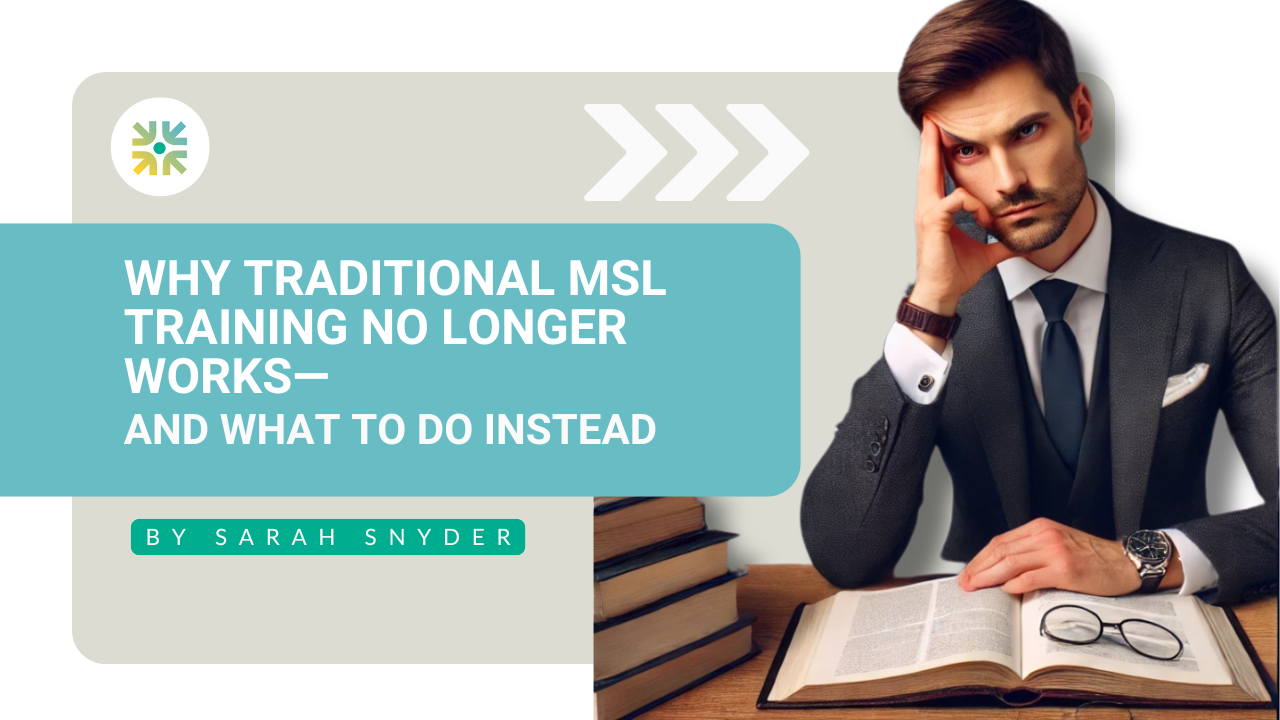
Picture this: A new MSL sits at their desk, surrounded by stacks of scientific articles and slide decks, diligently highlighting and taking notes. This has been the standard training approach for decades. Memorize the data, understand the endpoints, and hope that translates into meaningful KOL conversations.
It didn’t work in 2025. It really doesn’t work now.
In the last two years, the MSL role has changed more than it did in the previous 10 years. Access is harder. Metrics are more demanding. Certifications are more rigorous. MSLs are juggling multiple products, covering community-based providers alongside traditional KOLs, and shifting from individual relationship management to account-level strategy.
And now they’re expected to use AI tools on top of all of it.
Training hasn’t kept up. That’s a problem.
The Knowledge-Application Gap Is Getting Wider
Understanding data ≠ communicating data.
Traditional training assumes that an MSL who can recite endpoints can navigate sophisticated scientific dialogue. That assumption was always iffy. Now it’s just wrong.
Key Challenges:
1. MSLs read papers through an academic lens, not an HCP engagement lens. Memorization doesn’t build skills for dynamic, real-time conversations.
2. Training built around one product can’t prepare MSLs who are now expected to pivot between multiple products in the same HCP visit.
3. Training built around traditional KOLs doesn’t prepare MSLs for community physicians, APPs, and pharmacists who now make up a growing share of their territory.
Why Traditional Training Fails
Memorization Doesn’t Build Confidence—and the Metrics Are Proving It
Teams are being held to more rigorous insight capture standards, call quality benchmarks, and certification requirements. Traditional training isn’t closing that gap. It’s widening it.
An MSL might know the competitor achieved a 35% reduction in relapse rates. But when the KOL asks, “What’s driving that difference?”, the MSL can’t answer because they were trained to deliver data, not takeaways.
The Stakeholder Map Has Changed
Clinical conversations have never been about one product in isolation. But now MSLs need comparative thinking across their entire portfolio, in real time, while also adapting their approach for a community hospitalist who has 8 minutes versus an academic KOL who wants to dig into the methodology.
These are fundamentally different conversations. Most training prepares MSLs for neither.
Account Thinking Is Now a Core Skill
The shift from individual KOL management to account-level strategy isn’t a future trend. It’s happening now. MSLs need to understand the full ecosystem of stakeholders influencing treatment decisions within a system or practice. That requires a different kind of preparation than memorizing study endpoints.
The Fix: Train for the Role That Actually Exists
- Scenario-Based Learning – Train MSLs to explain complex concepts under pressure, not in ideal conditions.
- Multi-Product Fluency – Build the cognitive flexibility to move between products without losing clarity or credibility.
- Stakeholder Adaptation – Train MSLs to shift their approach across KOLs, community providers, and account-level contacts.
- AI Integration – Teach MSLs to use AI responsibly for literature synthesis, pre-call planning, and takeaway generation—and to critically evaluate what AI gets wrong.
- Active Dialogue Practice – Develop the ability to steer conversations, not just survive them.
Research proves it: passive learning = 20% retention after 24 hours. Active learning = 80%.
From Data Delivery to Takeaway Creation
KOLs don’t need an MSL to recite data they already found on PubMed. They need a thought partner who can connect data to real-world clinical decisions, facilitate deeper conversations, and show up having done the preparation that makes every minute of limited access count.
What Works:
- Shift from Telling → Asking – Train MSLs to prompt deeper discussions:
- “How might this data influence your treatment decisions?”
- “What challenges do you see translating these findings to your patient population?”
- Build AI Literacy – MSLs who know how to use AI tools well—and how to catch AI errors—are more prepared, more efficient, and more credible.
- Train for Access Efficiency – Every touchpoint needs to deliver value. Because there may not be a next one.
The Bottom Line
The companies that win in 2026 are training MSLs for the role that actually exists—not the one from ten years ago.
MSLs today are doing more with less: more products, more stakeholder types, stricter metrics, and fewer opportunities to make an impression. The training has to match that reality.
Stop training for memorization. Start training for impact.
→ Learn individual skills with Presentation Mastery
→ Build a high-performing team with a custom corporate program.
Ready to build a training program that reflects what MSLs are actually facing? Let’s talk.
Subscribe to the Medical Affairs Newsletter That Will Make You Strategic
Get practical Medical Affairs tips on communication, AI, storytelling, proving impact, and more in your inbox every Friday morning 🎯