Why a ‘KOL List’ Isn’t a Territory Plan And What to Do Instead
Jan 09, 2026By Patrina Pellett, PhD
Emily had just passed her field certification test and officially became an MSL as an MSL. Her manager handed her a KOL list, shared a few high-level expectations, and sent her into the field to start “building relationships.”
She did what most new MSLs do. She worked the list. She booked meetings. Shared data. Checked names off. Stayed busy.
Three months in, something felt off. Some KOLs never responded. Others were polite but disengaged. A few had retired, moved, or clearly weren’t aligned with her company’s strategy. Meanwhile, most of her time was going to the easiest KOLs, not the most influential ones.
She was active… but not impactful.
And more importantly, she couldn’t clearly answer one question leadership cares deeply about:
“How is your work advancing medical strategy?”
Emily wasn’t failing. She was doing exactly what she was set up to do.
But she was managing a list, not leading a territory.
That realization hit when a senior MSL asked her:
“How are you deciding who to see, when to see them, and what each conversation is meant to accomplish?”
She didn’t have a real answer.
Because a KOL list tells you who exists in a territory. It doesn’t tell you where to focus, how to create value, or how to gather great insights.
And that’s the difference between an MSL who looks busy and one who becomes indispensable.
Why a KOL List Isn’t a Territory Plan
(And Why This Difference Determines Your Impact)
Most MSLs are given a KOL list and told, “Start here.” That’s not wrong. It’s just incomplete. A KOL list tells you who exists in a territory. A territory plan tells you where to focus, why it matters, and how your work advances medical strategy.
And leadership absolutely notices the difference.
A KOL List Optimizes for Activity
A Territory Plan Optimizes for Impact
A KOL list is static. It’s a snapshot in time, often outdated before you even step into the field.
A strong territory plan is dynamic. Top-performing MSLs expect their plan to evolve as they:
-
Learn who actually influences practice
-
Gather insights on the KOL's preferences
-
Adjust based on scientific priorities and field realities
They don’t just execute a schedule. They adapt their strategy based on what they learn.
That’s how territory plans stay relevant and valuable.
A KOL List Keeps You Busy.
A Territory Plan Makes You Visible.
If your primary goal is “meet with everyone on my list,” you’re optimizing for completion, not contribution. A real territory plan defines:
-
Who to prioritize based on influence, relevance, and opportunity
-
What success looks like for each relationship
-
How engagement supports medical strategy, not just coverage metrics
This is where the shift happens. Busy MSLs report activities. Strategic MSLs explain impact.
A KOL List Assumes Accuracy.
A Territory Plan Builds Verification In.
Most KOL lists are only 60–70% right. Some names are outdated. Some of the most influential voices aren’t on the list at all. New MSLs often try to “verify” by working top-to-bottom, which burns time and delays impact.
Strategic MSLs do this differently. A strong territory plan includes:
-
A prioritization logic before heavy investment
-
Early signals of responsiveness and alignment
-
Intentional checkpoints to reassess who truly matters
This prevents months of reactive course correction and accelerates meaningful engagement.
How to Transform a KOL List into a Strategic Territory Plan
If you’re ready to move beyond a passive list and create an actionable strategy, start by following these 5 steps:
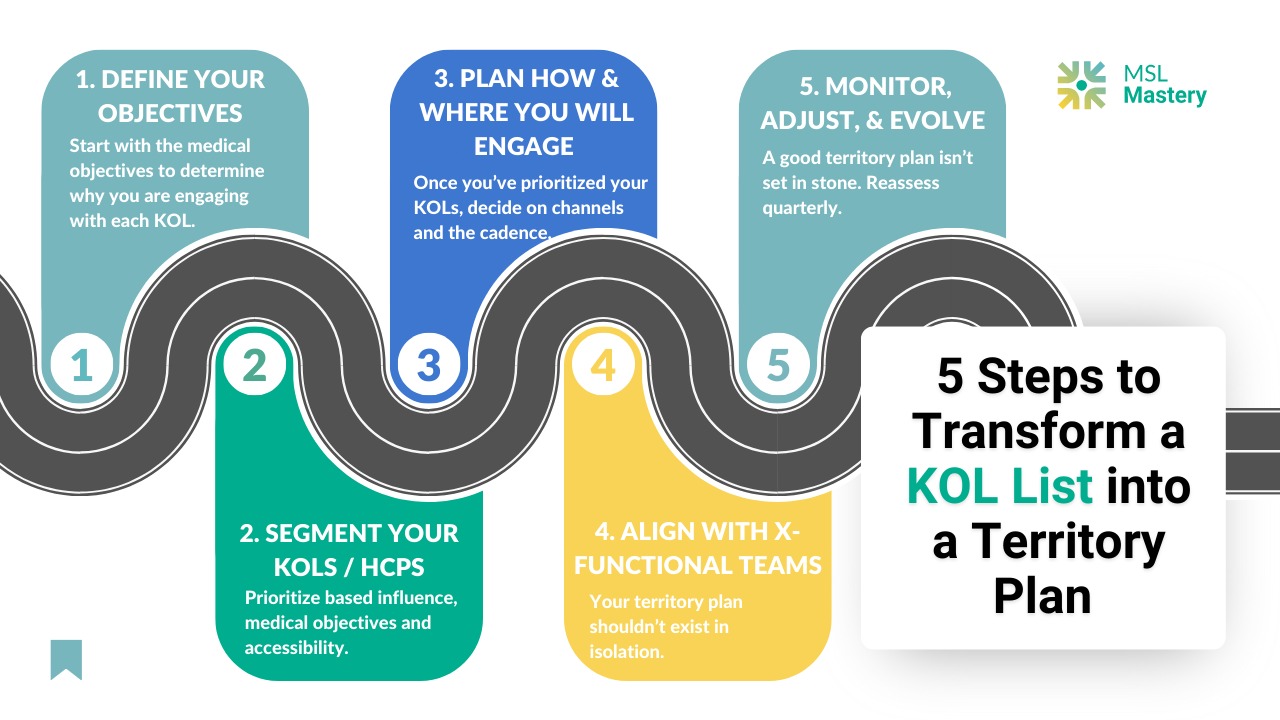
1. Define Your Objectives (Before You Schedule Anything)
Every KOL interaction should ladder up to a purpose.
Ask yourself:
-
What medical question are we trying to answer?
-
What gap are we trying to understand or influence?
-
What decisions could these insights inform?
Without this clarity, insights sound interesting, but rarely become decision-grade.
2. Segment Your KOLs
Not all KOLs require the same level of engagement. Strategic segmentation considers:
-
Scientific influence and credibility
-
Alignment with current and future priorities
-
Willingness to engage in meaningful dialogue
This ensures you are focusing on quality interactions over quantity. In a LinkedIn poll of nearly 1,000 respondents, a majority (54%) identified 26–50 as the “ideal” number of KOLs.
3. Plan How and Where You Will Engage
How you engage sends a message. Cadence, channel, and context all signal how important the relationship is to you and to the KOL. High-value territory plans define:
-
Where in-person time is truly warranted
-
Which conversations belong at congresses vs 1:1
-
What each interaction is meant to advance
Without this, conversations default to data delivery and stall there. Without a clear plan for what you’ll talk about, interactions can feel transactional instead of meaningful.
4. Align With Cross-Functional Teams
Your territory plan doesn’t exist in isolation. Ensure your engagements support:
- Market Access and reimbursement discussions
- Clinical trial recruitment goals
Collaborating with internal teams helps elevate your KOL discussions.
5. Reassess Ruthlessly and Regularly
The best territory plans are living strategies. High-impact MSLs regularly ask:
-
Which relationships are generating value?
-
Where am I over-investing with low return?
-
How have priorities shifted and what should change?
The best MSLs continuously refine their plans to ensure they stay relevant and effective.
Conclusions: Making the Shift From KOL List to Strategic Territory Plan
Many MSLs start with a reactive approach, meeting with KOLs as opportunities arise. But top-performing MSLs take control of their territory with a structured plan.
A strong territory plan helps you:
- Engage the right KOLs at the right time
- Deliver high-value scientific discussions instead of surface-level exchanges
- Reduce wasted time on inefficient scheduling and travel
- Align your efforts with business and medical strategy
If your team is still relying on KOL lists without a structured plan, it’s time to rethink the approach.
Knowing the Theory Isn’t the Problem. Execution Is.
Most Medical Affairs teams already know what good territory planning looks like. The challenge is doing it quickly, consistently, and in the real world.
That’s why in our MSL Territory Planning Team Training, we don’t rehash theory.
We train your team on a simple, 3-step system to turn any KOL list into a strategic territory plan fast.
No overbuilt templates. No academic exercises. Just a practical way to prioritize, plan, and execute with confidence.
If your team understands the concepts but struggles to apply them, this is how you close the gap.
Contact us today to learn more about our customized training program.
Subscribe to the Medical Affairs Newsletter That Will Make You Strategic
Get practical Medical Affairs tips on communication, AI, storytelling, proving impact, and more in your inbox every Friday morning 🎯