How Long Does It Take to Become an Effective MSL? What 858 Medical Science Liaisons Told Us
Jul 01, 2026By Sarah Snyder & Patrina Pellett
How Long Does It Take a New MSL to Become Effective?
Most Medical Science Liaisons take 1–2 years to become truly effective in the field, not just technically competent, but confident and high-performing.
A LinkedIn poll of 858 MSLs confirmed it:
→ 45% said 1–2 years,
→ 34% said 6–12 months, and
→ only 9% said less than six months.
The reason isn't lack of ability.
It's that new MSLs are simultaneously learning a new industry, a highly autonomous role, and a set of professional skills they've never been formally taught.
Why Does It Take So Long to Become an Effective MSL?
Every week, we hear some version of the same question from a new Medical Science Liaison:
"I've been in the role for six months. I know the data. I passed certification. Why do I still feel like I'm figuring everything out?"
It's an honest question and one that many new MSLs are almost afraid to ask. They assume everyone else adjusted more quickly! That they're somehow behind.
To find out what MSLs actually experience, we posted this question on LinkedIn:
How long does it take a new MSL to really get into the role?
Not just land the role. Not just complete onboarding. But truly understand what it takes to be effective.
858 MSLs responded. Here's what they said:
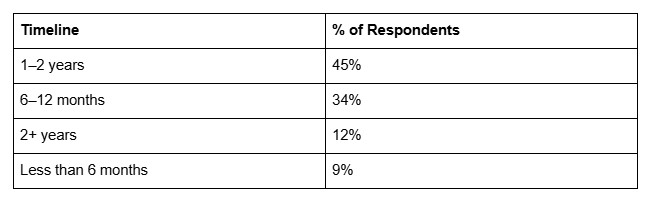
The takeaway isn't that the role is impossibly difficult. It's that most MSLs recognize a significant learning curve, one that extends well beyond product training and onboarding.
That matters because many organizations expect new MSLs to begin engaging healthcare professionals long before they feel fully prepared. In smaller biotech companies with leaner onboarding programs, that pressure is even greater.
The Real Reason the MSL Learning Curve Is So Long
After working with hundreds of aspiring and current MSLs, we've identified the core issue: new MSLs aren't learning one thing. They're learning three, simultaneously.
1. Learning to Navigate the Pharmaceutical Industry for the First Time
Most MSLs enter Medical Affairs from clinical practice, academia, or research. While those careers differ in many ways, they share one thing: a well-defined environment. Clinicians know their primary responsibility is patient care. Researchers are focused on a specific study.
Pharmaceutical companies operate differently.
As an MSL, your work sits within a complex, matrixed organization where success depends not only on scientific expertise, but on how you navigate relationships between Medical Affairs, Clinical Development, Medical Information, Commercial, and Compliance. Each function has different priorities and perspectives.
New MSLs frequently encounter questions they've never had to answer before:
Who needs to be informed when I gather a field insight?
When should Medical Information get involved?
How do I handle a request from a Commercial colleague?
When does Compliance need to weigh in?
These aren't questions most clinicians or researchers have had to navigate. They require judgment, and judgment develops through experience.
This is also where new MSLs discover that understanding compliance in theory is very different from applying it in the field. Annual compliance training teaches the rules. Knowing how those rules shape real conversations with healthcare professionals takes time.
If you're still calibrating your expectations of the role itself, this post is worth reading: What Aspiring MSLs Think the MSL Role Is vs. What It Actually Is.
2. Succeeding in an Autonomous MSL Role Without a Defined Playbook
This adjustment surprises even the highest performers.
Most people entering the MSL role are accustomed to structured environments: clinic schedules, research protocols, academic deadlines. There was always a clear sense of what needed to be accomplished each day.
The MSL role offers significant autonomy, but with that autonomy comes ambiguity.
You decide which healthcare professionals to prioritize. How often to engage them. When to travel. How to organize your schedule. How to balance competing demands from the field and internal stakeholders.
There's no checklist that tells you what an effective Tuesday should look like.
Instead, you're constantly balancing:
KOL outreach and relationship development
Internal meetings and cross-functional collaboration
Travel planning and congress preparation
CRM documentation and insight submissions
Compliance requirements and administrative work
Ongoing scientific learning
These activities all matter—and they all compete for the same limited time. (If you've never done a formal time audit, this one is built specifically for Medical Affairs.)
Relationship building also turns out to be harder than expected.
New MSLs often assume physicians will be eager to meet. Then the emails go unanswered. Meetings get cancelled twice before making it onto the calendar. Access that felt straightforward during onboarding suddenly becomes a real challenge.
Building credibility with healthcare professionals is a skill. Like any skill, it improves with practice. But most onboarding programs spend far more time on clinical data than on how to establish credibility, create value, and earn future conversations. These 6 resources for maximizing KOL engagement are a good starting point.
3. Building MSL Field Skills That No Clinical or Academic Career Teaches
This is perhaps the biggest reason the MSL learning curve is so long: many of the skills that define successful MSLs have nothing to do with science.
They're professional skills that weren't part of any degree program.
Within their first year, new MSLs are expected to:
Identify meaningful insights during scientific discussions
Document those insights in ways that are actionable for internal teams
Navigate difficult questions and manage objections from skeptical HCPs
Build long-term relationships with Key Opinion Leaders
Communicate effectively across internal functions
Develop and execute a territory strategy
Very few clinicians, pharmacists, nurses, or researchers have formally learned those skills before entering Medical Affairs.
Take insight gathering as an example. Most new MSLs understand what an insight is conceptually. What they struggle with is recognizing one during a conversation, asking the right follow-up questions in the moment, and documenting it clearly enough that internal stakeholders can act on it. We go deeper on this in Why Aspiring MSLs Need to Understand Insights.
The same gap exists for KOL access, objection handling, and territory management.
Experienced MSLs often make these skills look effortless—because they've been practicing for years. New MSLs are trying them for the first time.
Does MSL Tenure Guarantee Effectiveness in the Field?
Not necessarily—and a conversation with a Medical Affairs leader made this clear.
He shared that he was recommending an MSL with less than two years of experience for promotion, while choosing not to promote several MSLs who had been in the role much longer.
His reasoning wasn't based on tenure. It was based on growth.
The newer MSL consistently sought feedback, developed new skills, adapted quickly, and demonstrated sound judgment. Those qualities mattered more than simply accumulating years in the field.
Time creates the opportunity to learn. It doesn't guarantee it. More on this idea here: Never Leave Your Career Growth in Someone Else's Hands.
What New Medical Science Liaisons Should Expect in Their First Year
If you're still finding your footing after six months in the MSL role, you're in very good company.
The majority of experienced MSLs believe it takes far longer than that to feel truly comfortable and effective. The learning curve is real, and it's expected. What separates MSLs who thrive isn't avoiding the curve—it's seeking feedback, developing skills intentionally, and not waiting for the organization to guide every step of the process.
If you want a community of new MSLs navigating the same transition—and access to structured skill development—RISE was built specifically for you. In the meantime, these two posts are a great place to start: Thriving as a New MSL: 5 Make-or-Break Challenges and The Roadmap Every New MSL Needs to Succeed in Year One.
What Organizations Get Wrong About MSL Onboarding
For organizations, this data raises a more pressing question:
If most MSLs take 1–2 years to become effective, are we providing enough support after onboarding ends?
Traditional onboarding programs do an excellent job covering products, disease states, and company policies. Those are essential.
But they're only part of what makes someone successful in the field. We break down exactly where the gaps are in The 5 Biggest Reasons MSL Training Misses the Mark.
New MSLs also need practical development in:
KOL access and HCP engagement — how to earn meetings and build credibility
Insight gathering — how to recognize, capture, and communicate field insights
Objection handling — how to navigate challenging scientific conversations
Territory management — how to prioritize and build a strategic plan
Cross-functional collaboration — how to navigate the internal organization
The faster new MSLs develop these capabilities, the faster they become confident contributors—to both their external customers and their internal teams.
If you're a Medical Affairs leader looking to accelerate your team's development, book a training consultation call to talk through what your team needs.
Frequently Asked Questions About the MSL Learning Curve
How long does it take to become an effective Medical Science Liaison?
Based on a poll of 858 MSLs, 45% said it takes 1–2 years to become truly effective in the role. Another 34% said 6–12 months. Only 9% said less than six months. Industry research from pharmaceutical training organizations similarly shows that 18–24 months is a typical timeline for full acclimation.
Why is the MSL learning curve so long?
The MSL role requires new professionals to simultaneously learn a complex, matrixed pharmaceutical organization; succeed in a highly autonomous, unstructured role; and develop professional skills—like KOL engagement, insight gathering, and territory management—that were rarely taught in clinical, academic, or research settings.
What skills do new MSLs need to develop?
Beyond therapeutic area expertise, new MSLs typically need to develop skills in KOL relationship building, scientific communication with HCPs, field insight gathering, objection handling, territory strategy and prioritization, CRM documentation, and cross-functional collaboration with Commercial, Compliance, Medical Information, and Clinical Development.
Does tenure guarantee MSL effectiveness?
No. Medical Affairs leaders consistently report that growth mindset, coachability, and intentional skill development predict MSL performance more reliably than years of experience. MSLs who actively seek feedback and develop skills tend to advance faster than those who rely on tenure alone.
What can organizations do to shorten the MSL learning curve?
Organizations can accelerate MSL effectiveness by extending development support beyond initial onboarding. This includes providing structured coaching in KOL access, HCP engagement, insight gathering, objection handling, and territory management—the field skills that product and compliance training alone don't address.
The Bottom Line on the MSL Learning Curve
The first year as an MSL isn't difficult because people aren't capable.
It's difficult because they're learning three things at once: a new industry, a role without a defined playbook, and professional skills that no previous career required.
That combination takes time.
It's also why the overwhelming majority of MSLs in our poll said that becoming truly effective happens well beyond the end of onboarding.
The goal isn't to eliminate the learning curve. The goal is to make sure new MSLs don't have to navigate it alone.
At MSL Mastery, we train and develop Medical Science Liaisons and the managers who lead them. New MSL? Join RISE, our community built for MSLs in their first two years. Leading a team? Book a training consultation to talk through what your team needs.
Subscribe to the Medical Affairs Newsletter That Will Make You Strategic
Get practical Medical Affairs tips on communication, AI, storytelling, proving impact, and more in your inbox every Friday morning 🎯