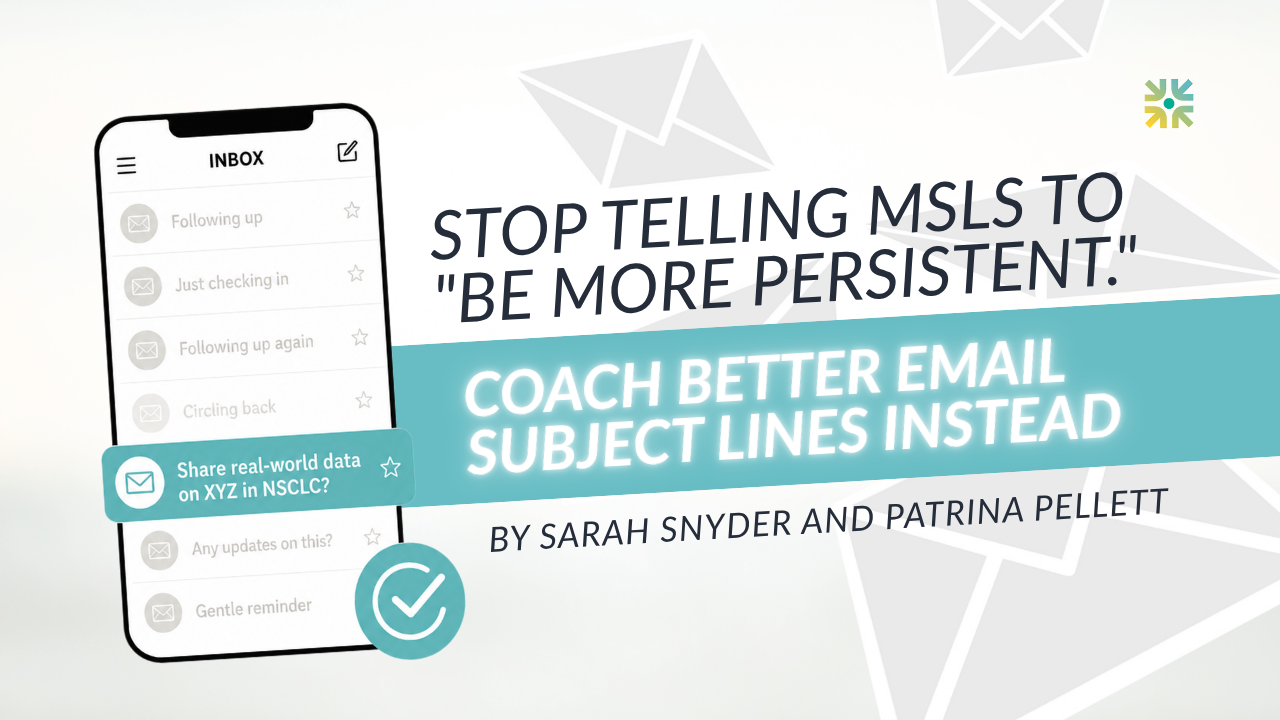
Stop Telling MSLs to "Be More Persistent." Coach Better Email Subject Lines Instead
Jul 28, 2026By Sarah Snyder and Patrina Pellett
A KOL isn't responding.
So the manager says the thing every manager says:
"Just follow up again. Be persistent."
The MSL follows up again. Same silence.
In an MSL Mastery LinkedIn poll, 47% of MSLs said fewer than 1 in 10 of their cold emails work, and 84% said their success rate is under 25% (n=607). This isn't a persistence problem. It's a "nobody opened it" problem.
But "be more persistent" isn't coaching. It's a wish.
You've told someone to try harder without telling them what to change. So they send the same email a third time, feel worse about it, and quietly decide this HCP is a lost cause.
Persistence isn't the problem. Persistence pointed at a broken email is just more broken email.
Your MSLs are already persistent. In another poll, 84% said they follow up three or more times, or never really give up, before walking away from a KOL (n=503). The effort is there. The subject line is what's wasting it.
If your MSL's outreach isn't getting responses, don't tell them to send more. Coach them to look at the one thing almost nobody was ever taught to write:
The subject line.
Why the Email Subject Line Is the Fastest MSL Skill to Coach
Nobody teaches subject lines. Not in grad school, not in a fellowship, not in most MSL onboarding. We train MSLs on the science, the slides, and the compliance guardrails, then hand them an inbox and assume the email part takes care of itself.
It doesn't. And the subject line is the very first thing your KOL sees.
Before they read a word of your carefully written message, they see a name and a line of text on a locked phone screen. In that moment they make one decision: open, or ignore.
That's what makes the subject line the best diagnostic you have as a leader. It's fast, it's specific, and it's fixable in a single coaching conversation. You don't need to shadow 10 calls to figure out why outreach is stalling. You can look at five subject lines and usually see it immediately.
How Many Emails Does a Physician Get a Day? The Inbox You're Competing In
Your MSL isn't competing with other MSLs. They're competing with the entire inbox.
The average professional gets around 120 emails a day. Physicians sit on top of that with clinical systems, EHR message baskets, and organizational email. The American Medical Association has reported that U.S. physicians carry some of the heaviest inbox loads of any workers, anywhere.
And here's how fast the decision happens: most people decide whether to open an email in under a second. One glance at the sender and the subject line.
That glance is doing almost all the work. Studies consistently find that around 47% of people open an email based on the subject line alone, and roughly 64% decide whether to open or delete based on it. Not the body. Not your data. The subject line.
So when a KOL "ignores" your MSL, most of the time they didn't reject the message.
They never saw it. It lost the one-second glance.
Getting Opened vs. Getting a Reply: What MSL Outreach Should Actually Aim For
Let's be clear about what we're optimizing for. A good subject line gets the email opened, but an open is just the ticket in. The goal is a reply.
That distinction matters, because it changes what a "good" subject line even is. A clickbait line might win the open and lose the relationship. What you want is a subject line that makes an open and sets up a response: clear about who you are, why you're worth two minutes, and what you want back.
And this isn't only a field problem.
The same rule runs your MSL's internal life. The message to the medical director who needs to approve an advisory board. The ask to the brand team for the updated deck. The nudge to a colleague sitting on the data your MSL needs. Internal emails get scanned in the same one second as external ones. "Circling back" buried under a vague subject line dies the same quiet death.
If you coach this once, it pays off in both directions: better KOL access and faster internal turnaround.
3 Principles for Writing MSL Email Subject Lines That Get Responses
Here's the simple framework to teach your team. Three principles. Every subject line should pass all three.
1. Make It Specific to the HCP, Not Generic
Generic subject lines say nothing, so they get treated like nothing. The fix is to name something only this person would recognize: a topic they raised, a session they're speaking at, a patient population they care about.
→ Generic: "Follow up" → Specific: "The MOA question you raised at ASCO"
Same email. The second one earns the second.
2. Lead With Value or Curiosity, Not Your MSL Title
Most MSL subject lines announce the sender. "MSL introduction." "Medical Science Liaison, [Company]." That tells the HCP about you, not about why they should care.
Flip it. Put the value or the open loop up front. It's the same reason a story beats a data dump: you're giving them a reason to care before you ask for anything.
→ Title dump: "Introduction from your MSL" → Value: "A new subgroup analysis for your CLL patients" → Curiosity: "One slide from the trial you asked about"
3. Keep It Short Enough for a Phone Screen (Under 70 Characters)
A subject line the HCP can't finish reading is a subject line that didn't work. Keep it under about 70 characters and front-load the important words, so the point survives even when the line gets cut off at "..."
→ Too long: "Following up on our previous conversation regarding the recent data presentation and next steps" → Tight: "Next step on the data you flagged"
Coach the principles, not a script. The moment you hand your team a template, they'll send the same template to everyone, which brings us to the biggest mistake of all.
The Biggest MSL Email Mistake: Sending the Same Subject Line to Everyone
The fastest way to get ignored is to write one subject line and reuse it on the whole KOL list.
Sameness reads as mass email, and mass email gets deleted on sight, because the HCP can feel that nobody wrote it for them. Specificity is the entire advantage. The instant it's copy-paste, the advantage is gone.
So the real coaching goal isn't "write a good subject line once." It's to write a subject line that could only have gone to this one person. If your team isn't leveraging AI Agents for this, ping us. We can help your team save hours on this.
How to Turn Subject-Line Writing Into an AI Agent
Once your MSLs can spot the difference between a specific subject line and a generic one, you can systemize it.
This is exactly the kind of repeatable, judgment-light task that AI is built for (here are three more ways medical affairs teams are using AI agents). Your MSL feeds in the context, who the HCP is, what they last discussed, what the email is about, and a well-built agent drafts three subject-line options that pass all three principles. The MSL picks the sharpest one and sends.
That's the shift from hoping people write good subject lines to building the skill into the workflow. We build exactly this kind of agent with teams as part of our training. Sign up to learn more about our team training.
Want to sharpen the writing first? Our Subject Line Workshop is a hands-on session for individuals where we actually write subject lines together, applying the 3 principles above to real field and internal examples.
But if you’re thinking, How can we build an agent when the team doesn’t know what good looks like? You’re asking the right question.
In our Email Lab program, we flip email writing on its head. MSLs don’t start by trying to dream up a clever subject line. They start with the strategy: Who is this for? Why should they care? What would make replying worth their time?
Then they write the email. The subject line comes last.
This approach has taken many MSLs from open rates below 10% to over 50%. Because once the strategy is clear, the subject line stops being a guessing game.
Bring the Email Lab Training Program to your team.
Coaching Persistence: The Real Takeaway for Medical Affairs Leaders
"Be more persistent" tells your MSL to push harder on a door that isn't opening. Coaching the subject line hands them the key.
It's not about sending more email. It's about earning the one-second glance, then turning it into a reply. And when the follow-up finally connects, what you do next is what turns a single reply into a relationship.
That's not a personality trait. It's a skill. And skills can be coached, on purpose.
FAQ: MSL Email Subject Lines and KOL Outreach
Why aren't my MSLs getting responses to their KOL outreach?
Usually not because the message is bad. It never gets opened. Around 47% of people open an email based on the subject line alone, and most decide in under a second. If outreach is stalling, audit the subject lines before you add more follow-ups.
Is "be more persistent" good coaching for MSLs?
No. It tells an MSL to try harder without telling them what to change, so they resend the same ineffective email. Effective coaching targets a specific, fixable variable, starting with the subject line.
What makes a good MSL email subject line?
Three things: it's specific to that one HCP, it leads with value or curiosity instead of your job title, and it's short enough (under ~70 characters) to read on a locked phone screen. And it should never be identical across your KOL list.
Do subject lines matter for internal medical affairs emails too?
Yes. Internal emails get scanned in the same one second as external ones. The same three principles help MSLs get faster responses from medical directors, brand teams, and colleagues.
What is Email Lab training for MSLs?
Email Lab is practical MSL email training focused on improving subject lines and outreach messages. It helps MSLs apply clear, specific writing principles to the external and internal emails they send every day.
The Email and Subject Line Statistics Behind This Post
- The average professional receives roughly 120 emails per day.
- U.S. physicians carry some of the heaviest inbox loads of any profession, on top of clinical and EHR messaging systems (American Medical Association).
- Most people decide whether to open an email in under a second. Around 47% open based on the subject line alone, and roughly 64% decide whether to open or delete based on the subject line.
- Subject lines under about 70 characters earn the highest open rates, and personalized subject lines lift open rates from about 35% to 46%.
Subscribe to the Medical Affairs Newsletter That Will Make You Strategic
Get practical Medical Affairs tips on communication, AI, storytelling, proving impact, and more in your inbox every Friday morning 🎯