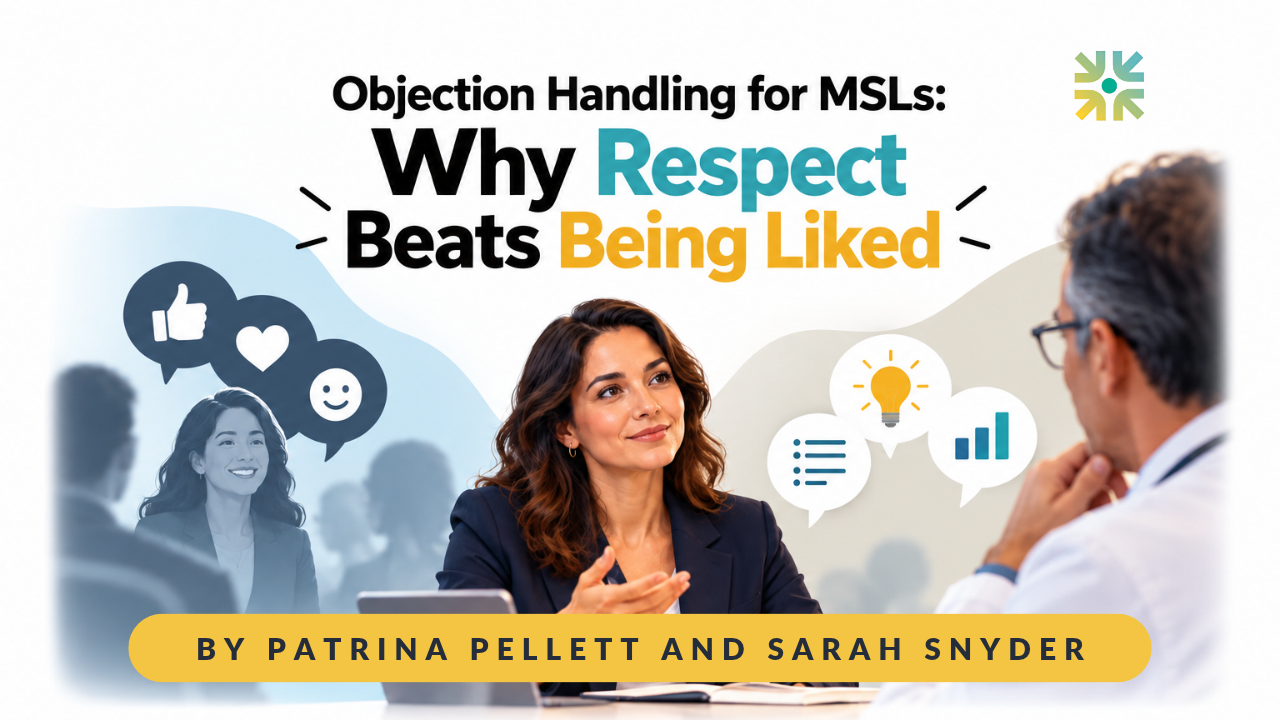
Objection Handling for MSLs: Why Respect Beats Being Liked
Oct 31, 2026By Patrina Pellett, PhD, and Sarah Snyder, PharmD, Co-CEOs of MSL Mastery
Updated 2026-10-28
Objection handling for MSLs means understanding what a KOL is really worried about before you answer it (getting to the root cause!). Work out whether the challenge is a real question or a heated reaction. Then respond to the concern with balanced, accurate science. The goal is respect, which earns you the next meeting.
You walk into a KOL meeting with your deck ready and a clear agenda. Then the KOL tells you the data doesn't apply to their patients. Your stomach drops, and every instinct says: pull up the primary endpoint, right now.
Most MSLs have been there. The objection feels like a test, so the reflex is to win it. But the KOLs who push back are often the ones who care enough to engage. And the friendly KOL who nods along and never shares a concern? That meeting feels great. But it leaves your leadership with nothing to act on and doesn't move the needle.
You're not alone. In a December 2025 MSL Mastery LinkedIn poll, we asked MSLs what makes objection handling most challenging during scientific discussions. Of 194 responses, the top answer was bridging back to the goal (33%), followed by not getting defensive (27%), not knowing what to expect (22%), and not knowing what to say (18%).
This guide walks through the whole meeting, from the 1st minute to the follow-up you send afterward. Being liked is nice. Being respected is what gets you a 2nd meeting.
What is objection handling for MSLs?
Objection handling for MSLs means responding to a KOL's challenge with accurate scientific info, after you understand the concern behind it and get the insight. It isn't a sales technique. You're aiming for an informed KOL, not a closed deal.
| Sales objection handling | MSL objection handling | |
|---|---|---|
| Goal | Overcome the objection and move to a close | Understand the concern and share balanced science |
| First move | Counter or reframe | Find out what's behind the challenge (the insight!) |
| Success looks like | The customer agrees to buy | The KOL feels heard and knows where to find the evidence |
| Biggest risk | Pushing past a real concern | Over-explaining, data dumping or drifting into promotion |
Why does respect matter more than being liked for MSL-KOL relationships?
Respect matters more because it's what builds a peer-to-peer relationship. A KOL who challenges your data and listens to the answer is engaging with you. A warm KOL who never pushes back gives your team very little to act on. And is probably just trying to get you out of the office.
Here's an example, built from patterns MSLs describe often.
Dr. A is warm. Every meeting starts with coffee and a compliment about the last publication, transitioning to showing data slides with a lot of head nodding. The MSL walks out feeling great. Three months later, nothing has changed. The MSL doesn't really know anything about this doctor and the rationale behind his or her thinking. Dr. A has never shared a single concern, so the medical team has nothing to act on.
Dr. B is tougher. Ten minutes in, she tells the MSL she doesn't trust the data for her patients. The MSL has a deck ready and feels the pull to defend it. Instead, the MSL asks, “Tell me what you're seeing.” Dr. B talks for 10 minutes about patients who don't respond the way the trial suggested, and the MSL takes notes. Only then does the MSL explain what the trial couldn't answer and where the authors themselves urge caution.
Dr. B's reply: “Nobody has explained that to me before.”
Two weeks later, on the exact day the MSL promised, the response Dr. B asked for lands in her inbox. Dr. B books another meeting, and this time she brings her colleague.
So what earned Dr. B's trust? The MSL asked a question before jumping into the data, focused on data that actually matters to this person, and did exactly what she said she'd do. Those first 10 minutes probably weren't comfortable. But comfort didn't earn the second meeting. Trust did.
How does an MSL set up a KOL meeting so objections go well?
Say the goal out loud in the first 60 seconds, set an agenda, and name the anticipated objection early. Together, those 3 moves tell the KOL what the meeting is for, why it's worth their time and proves the MSL was listening last time.
- Say the goal.
- Set an agenda.
- Name the anticipated objection early.
Bonus: Use “we” language throughout. “Here's what we can work through together” sounds like a conversation. “Here's what I'd like to show you” sounds like a presentation.
How do MSLs respond to pushback without getting defensive?
Decide first whether the challenge is a real question or a heated reaction. A real question gets one or two clarifying questions. A heated reaction gets an acknowledgment first, then a question.
For a real question: “Can you tell me more about what you're seeing?”
For a heated reaction: “That's a fair frustration. Let's look at what the data can and can't tell us.”
One of the most common mistakes? Pulling up a slide before you understand the concern. It makes the KOL feel managed. Even a follow-up question can backfire when someone's frustrated, because it can sound like you're handling them. So acknowledge first, then ask.
When you do answer, make one point, in your own words, that speaks directly to their concern. A scripted answer sounds like a pitch. A slide dump sends the KOL's eyes to the clock. Once you've answered, bridge back to the goal you set at the start, so the objection moves the meeting forward instead of ending it.
What should an MSL do after the meeting to earn the next one and add value?
Deliver what you promised, on time, and reference the specific challenge in your follow-up. Show you were listening and give the KOL a reason to meet again.
Log each challenge with CWI to turn into impact for your team
Challenges and the rationale behind them are incredibly useful for your team and company. Use CWI, MSL Mastery's insights framework, to log every challenge. CWI stands for Context, the Why, and Implications. Context is who raised it and in what situation. The Why is the reasoning behind it. Implications are what it could mean for the medical strategy. A challenge logged this way is useful to your team and potentially a decision-grade insight.
Debrief yourself within 5 minutes
If objections from KOLs make you uncomfortable, that's totally normal. Your reaction to a tough challenge is something you can control and train. Here's how to coach yourself to handle objections. Ask yourself 3 questions:
- What mattered about this conversation?
- What happened in the moment I reacted?
- What will I do differently next time?
Your own reactions are some of the most useful coaching data you'll ever collect. Reflect on this and look for patterns to help make a plan for next time. Better yet: pop this into AI and ask for additional coaching insights.
Key takeaways: objection handling for MSLs in KOL meetings
Good objection handling for MSLs comes down to 3 moves:
- Ask clarifying questions before jumping to the data
- Share the data that is relevant to the root cause of the objection
- Follow through on exactly what you promised
An objection isn’t something to shut down. It’s a KOL telling you what they really think, and most meetings never get that far. Remember objections = insights!
Do this well, and the KOL who pushed back hardest becomes the one who says yes to the next meeting, and you build the long-term peer-to-peer relationship. Every challenge you log with CWI also gives your team field evidence leadership can use. That’s how one tough conversation turns into impact people can see.
How does MSL Mastery train teams on objection handling?
When Sarah was an MSL, she didn't find any of the objection handling training helpful. They often said to fire back a question right away to 'handle' the objection. You can't say to an angry/frustrated KOL: "What makes you feel that way?"
That's why Sarah turned the method she used in the field for 20 years into a repeatable framework for MSL teams: the tennis ball or fireball technique. It makes more sense in the training!
MSL Mastery trains medical affairs teams in live virtual or in-person sessions built around your team's KOL challenges. Teams practice their responses in small breakout groups and debrief together, so they've rehearsed the skills before their next real KOL meeting and build resources they can use in the field.
For teams that want to go deeper, MSL Mastery's Crucial Conversations training comes in two formats: one 3-hour live session, or three 60-minute sessions where we train your team on techniques to handle objections before, during and after the meeting.
Frequently asked questions
What is the best way for an MSL to handle an objection from a KOL?
Understand the concern before you respond. Decide whether the challenge is a real question or a heated reaction, ask about the reasoning behind it, then answer the concern with balanced, accurate science. Follow through on anything you promised.
Which programs teach KOL relationship building for new MSLs?
Look for live training that uses real KOL scenarios, not just slides. Teams should practice their responses and debrief together. Ask the vendor to show you the scenarios and the practice format before you invest.
How does MSL Mastery train teams on KOL engagement?
MSL Mastery runs live virtual or in-person sessions built around real KOL challenges. Teams practice their responses, work in breakout groups, and debrief together. Our Crucial Conversations training runs as one 3-hour live session or three 60-minute sessions. We are tool-agnostic, so teams can prepare with whichever company-approved tool they use.
Should an MSL try to be liked by KOLs?
No. Respect is the better goal. A KOL who challenges your data and listens to the answer is building a working relationship with you. A warm KOL who never engages gives your team very little to act on.
What is the difference between a real question and a heated objection?
A real question asks for information in a curious tone. A heated objection shows frustration, doubt about your credibility, or strong emotion. Answer a real question with a clarifying question. Acknowledge a heated objection first, then ask.
How do I turn an objection into a second meeting?
Follow through on what you promised, on time, and reference the specific challenge in your follow-up. Show the KOL where the evidence discusses its limits. Following through is the most reliable way to earn the next conversation.
Talk through your team's KOL challenges
Want to talk through your team's toughest KOL conversations? Book a team consultation call.
About the authors
Written by Patrina Pellett, PhD, and Sarah Snyder, PharmD, Co-CEOs of MSL Mastery. Sarah spent 20+ years in the field as an MSL. Patrina built the frameworks teams now use to turn field work into impact that leadership can see.
Subscribe to the Medical Affairs Newsletter That Will Make You Strategic
Get practical Medical Affairs tips on communication, AI, storytelling, proving impact, and more in your inbox every Friday morning 🎯