
This happens in our trainings all the time:
We’ll introduce a framework for KOL prep, insights, follow-up, territory planning, whatever we’re working on. And one of the Sr MSLs will say:
“That’s basically what I already do.”
Exactly. But only in their heads.
Years of experience have taught them what to look for, what matters, what to ignore, and what to do next. But here’s where AI changes things:
The process can’t stay in their head anymore.
If you want AI to give you and your team superpowers, you have to write it down and document it well.
→ What are the steps?
→ What information goes in?
→ When does a critical decision get made
Once you map that out, you can start asking the much more interesting question:
Where can AI make this workflow faster, better, or more consistent?
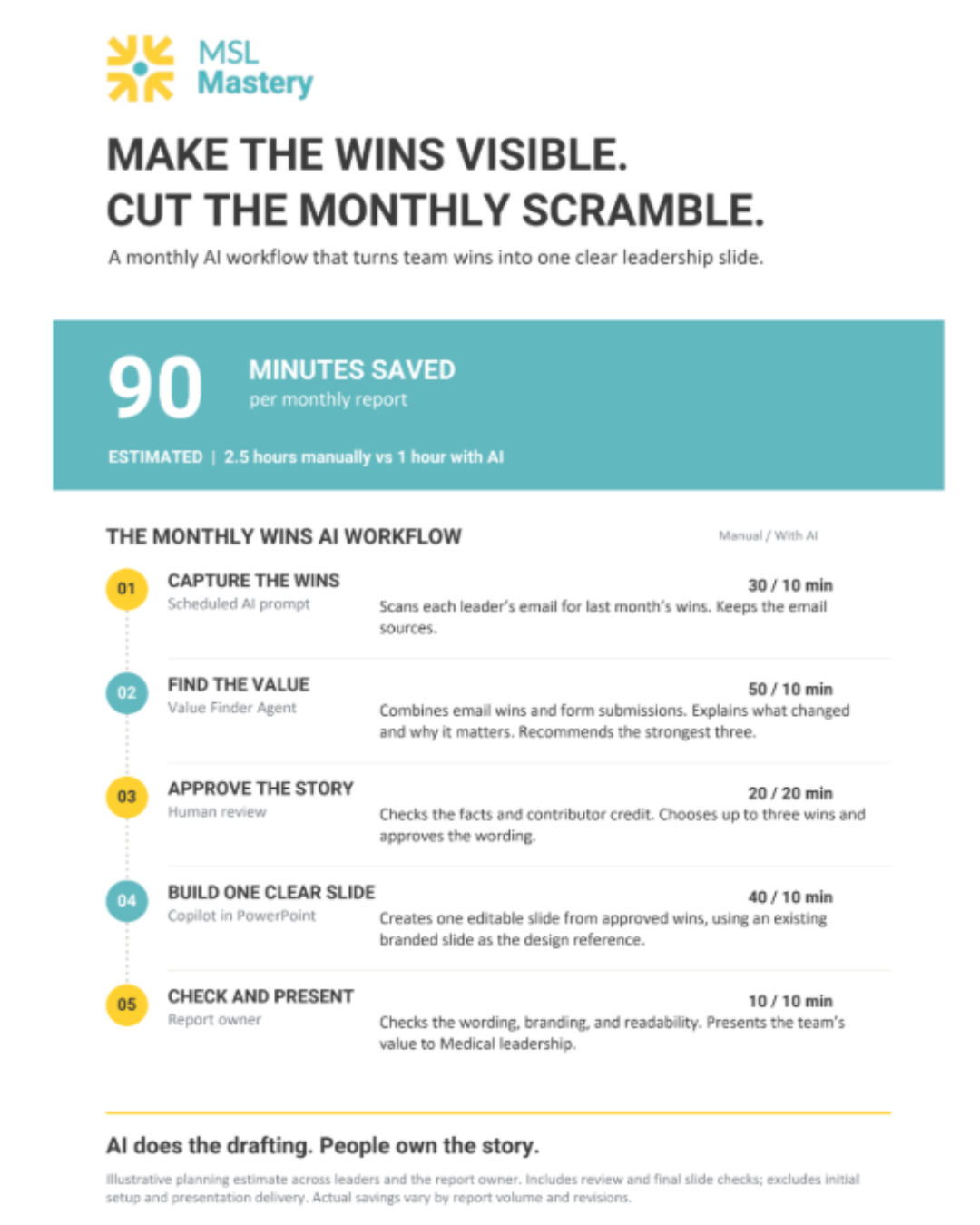
That’s what this issue is about: getting your best thinking out of people’s heads, turning it into an actual workflow, and then plugging in AI (or not). And here’s one of our favorite AI workflows we built to save Medical Affairs leaders time on reporting wins to inspire you:
1. Map the work before you add AI
A lot of teams start with: “How can we use AI for KOL prep?”
You should start one step earlier: How does a really good MSL actually prep for a KOL meeting?
Not the SOP version. The “what actually works” version.
What do they check first? What makes them dig deeper? What do they automatically ignore? When do they change course?
That is the stuff you need to get out of their head. And that is your workflow.
2. Steal this prompt to map your workflow
Use this with yourself, a Sr. MSL, or anyone who has a process they know so well they barely realize they’re doing it.
Prompt:
"Act as an expert process engineer and workflow consultant.
Help me document how I currently complete [TASK] so I can identify where AI could help.
Interview me one question at a time to uncover:
- The steps I take
- The information, tools, and sources I use
- The decisions I make
- Where experience or judgment matters
- What takes the most time
- Where the process tends to break down
Ask follow-up questions if I skip a step or give a vague answer.
When we’re done, map the workflow clearly and identify the top 3 places where AI could make it faster, better, or more consistent without removing important human thinking.
3. This has to be how AI training is done now
. This has to be how AI training is done now
This has become a routine part of how we design AI training for Medical Affairs teams. We don’t just show up with a bunch of shiny AI tricks. We 1st understand how the team actually works.
How do they prep? Where does the information live? What tools can they access? Where are they wasting time? Where does real human thinking matter?
Then we build the AI into their workflow, in their environment, and train the team on how to use it.
What's the point of training on AI if people are just going to ignore it again a week later? Building it into an existing workflow is how to make AI adoption happen. Then the next step is strategic AI use.
TL;DR
AI workflows don’t start with AI.
1. Get the process out of someone’s head.
2. Map how the work actually gets done.
3. Plug AI into the places where it can genuinely help.
Your Sr MSLs may already know the best way to do the work. Now you need to make that thinking visible.
In your corner always,
Patrina, Sarah, & Ralph
P.S. This is exactly what we do now in our AI training: understand the workflow, build AI into the real work, then train the team to use it. If your team is ready to move beyond random prompts and start building real AI workflows, reply “AI.”
Upcoming MSL Mastery Events
 |
 |
|
 |
|
|
 |
|
|
 |
|
|
 |
|
|
For MSL Mastery Members
 |
|
|
 |
|
|
 |
|
|
Watch On-Demand
 |
|
|
 |
|
|

Responses